

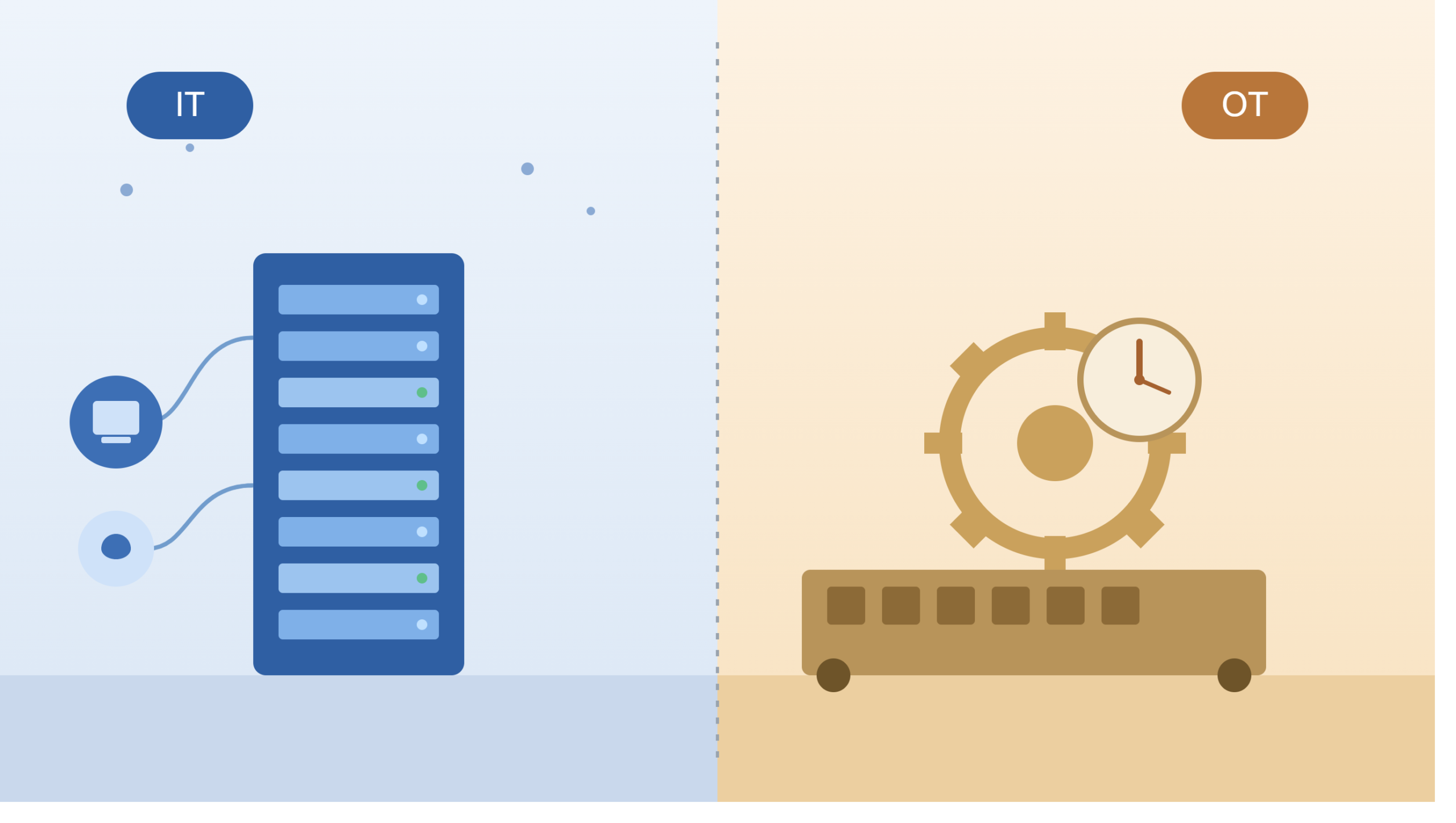
For decades, Information Technology (IT) and Operational Technology (OT) networks evolved on separate tracks, serving different purposes and built on different assumptions. As factories, power plants, and utilities increasingly connect their industrial systems to corporate networks, understanding the distinction between these two worlds has become essential for security and operations alike.
What Each Network Does
IT networks manage the flow of digital information across an organization: email, databases, file sharing, business applications, and enterprise resource planning systems. Their primary function is processing and moving data to support business operations, decision-making, and communication between people and systems.
OT networks, by contrast, control physical processes and machinery. They run the programmable logic controllers (PLCs), supervisory control and data acquisition (SCADA) systems, distributed control systems (DCS), and sensors that operate manufacturing lines, pipelines, power grids, and water treatment facilities. OT doesn’t just move information, it directly controls valves, motors, robotic arms, and turbines in the physical world.
Core Priorities: CIA vs. AIC
This functional difference produces opposite security priorities. IT security traditionally follows the CIA triad: Confidentiality first, then Integrity, then Availability. Protecting sensitive data from unauthorized access is paramount, even if that means taking a system offline temporarily to patch a vulnerability.
OT flips this hierarchy to AIC: Availability comes first, followed by Integrity, then Confidentiality. A power plant or assembly line cannot simply “reboot to apply a patch” the way a laptop can. Downtime can mean safety hazards, environmental damage, or millions of dollars in lost production per hour. This is why OT environments often run on outdated operating systems with known vulnerabilities thus taking the system down to update it poses a greater operational risk than the vulnerability itself.
Lifespan and Change Tolerance
IT equipment typically cycles every three to five years, with frequent software updates expected and routine. OT equipment, on the other hand, is built to last fifteen to twenty-five years or more. A control system installed in 1998 might still be running critical infrastructure today, often on legacy protocols like Modbus or DNP3 that were never designed with cybersecurity in mind, since they predate the era of networked threats.
This longevity creates a patching paradox: OT systems are simultaneously the hardest to update and among the most attractive targets for attackers, since their vulnerabilities remain unaddressed for years.
Consequences of Failure
Perhaps the starkest contrast lies in the consequences of compromise. An IT breach typically results in data theft, financial loss, or reputational damage. An OT breach can cause physical consequences: explosions, toxic releases, power outages affecting hospitals, or contaminated water supplies. This elevates OT security from a business risk to a matter of public safety.
Convergence and Its Challenges
The rise of Industrial Internet of Things (IIoT) devices and the drive for operational efficiency have pushed IT and OT networks closer together, connecting once-isolated control systems to corporate networks and the internet. This convergence enables valuable data analytics and remote monitoring but also exposes fragile, legacy OT systems to threats they were never designed to withstand.
Bridging these two worlds successfully requires more than firewalls—it demands cross-disciplinary teams who understand both the data-centric mindset of IT and the safety-critical, uptime-obsessed culture of OT.